Talk with our engineers by joining the new Onehouse community Slack!
Announcing Onehouse lakeGRES™
Lakegres: Real-Time Lakehouse Queries from Any Postgres Client
The world’s first lakehouse serving layer with database capabilities like indexing and caching. Built for both machines and humans. Handling high-QPS, low-latency queries from AI agents as well as heavy analytics.

Finally, a Serving Layer for the Lakehouse
For years, teams needing low-latency queries have been forced to either copy data into a data warehouse or operate parallel systems—adding cost and complexity while giving up the core storage and compute efficiencies of the lakehouse. That tradeoff might have been tolerable for human-driven analytics, but no longer sustainable for AI agents that generate queries at 10× the speed and scale.
Lakegres rips these bandaids off, by serving high-QPS, low-latency queries directly from your Apache Hudi™ or Apache Iceberg™ tables through a highly available, autoscaling, Postgres-compatible SQL endpoint. With intelligent indexing and caching, Lakegres delivers database-like responsiveness for interactive analytics and agent-driven exploration without ever moving data out of your lakehouse.

Full-Fledged Database Functionality
Automatic indexing and multi-tier caching deliver low-latency SQL directly on Iceberg/Hudi without copying data into a warehouse. Your AI Agents can do large joins in O(N) time with high-cardinality filters in seconds and needle-in-haystack lookups in milliseconds.
High QPS, Low-Latency Agent-Scale Querying
Trino and Apache Spark™ scale poorly beyond low-qps, low-concurrency querying due to architectural limitations. Lakegres implements the tried-and-tested server design techniques like non-blocking I/O, event queues, http 2/3 networking to maximize throughput and concurrency.
Open & Interoperable
Built on Hudi and Iceberg open table formats and ANSI-SQL for a zero lock-in architecture. Just point your existing Postgres clients to Lakegres to get going. Govern your data using your existing catalogs like AWS LakeFormation.
Production-Safe AI Architectures
Let AI agents run heavy, ad hoc queries without touching your operational databases. Replicate your operational data using OneFlow and Lakegres serves it directly behind a Postgres-compatible endpoint so exploration is fast, isolated, and safe for production.
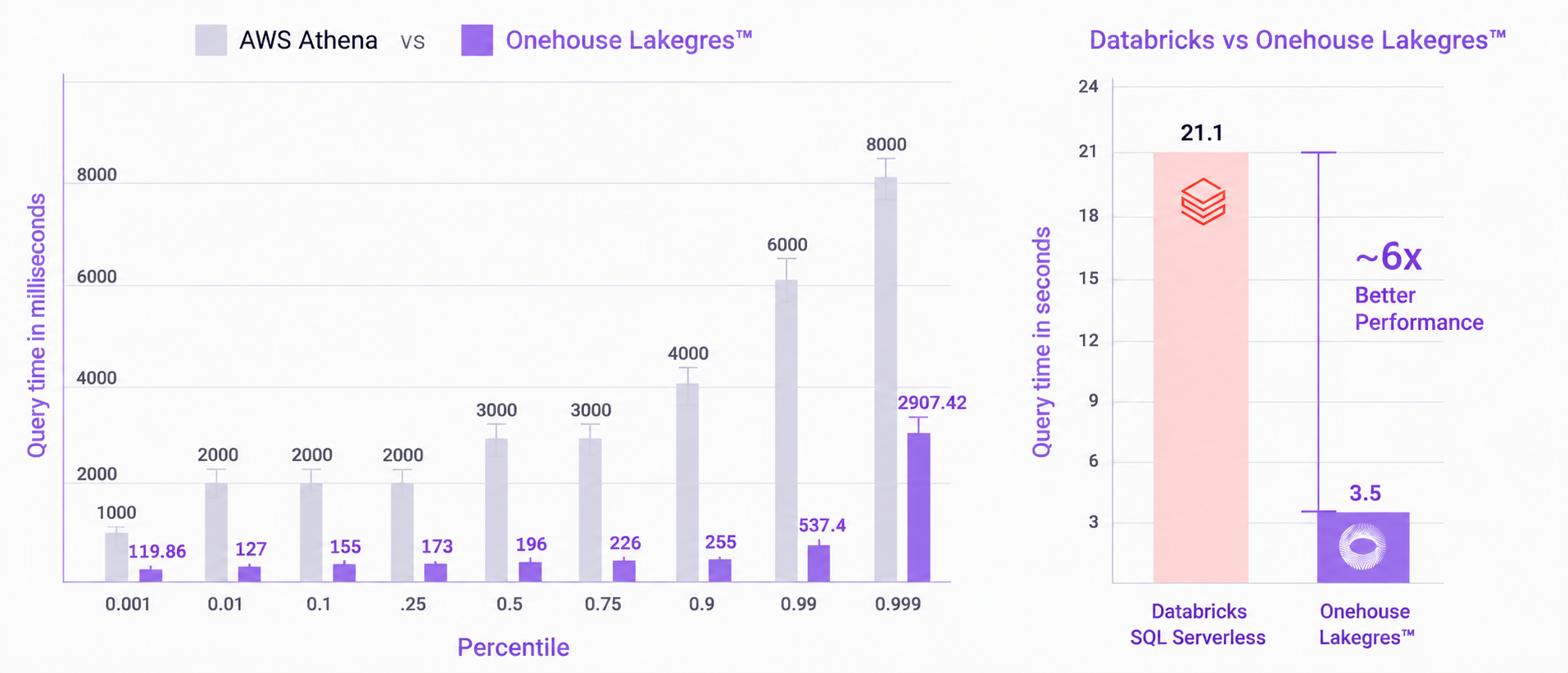
Database-Speed at Lakehouse Scale
Powered by unique innovations, including:
- Intelligent indexing for point-lookups, ad hoc queries
- O(N) Index Joins to speed up data exploration 6x
- Columnar caching that avoids unnecessary compute overheads.
- Transactional caching that keeps queries always consistent with table commits.
- Vertical autoscaling based on query volumes
- Horizontal autoscaling to absorb unpredictable demand or spikes
Getting Started is Easy
1
Ingest
2
Connect
3
Serve
Ingest your data
Connect to a serving endpoint
Query fast from agents
Start Your Free Trial
A Postgres-compatible serving endpoint for Iceberg and Hudi, with intelligent indexing and caching for millisecond lookups and fast analytics at high concurrency.